
Most marketing teams already know that generic email blasts underperform. What they don't have is a system for replacing them.
That's the gap this guide closes. You'll get a five-step playbook for building personalized customer journeys across email, SMS, push, and WhatsApp — plus the technical reasoning behind why behavioral personalization outperforms demographic targeting, and a decision framework for evaluating the platform you'll run it on.
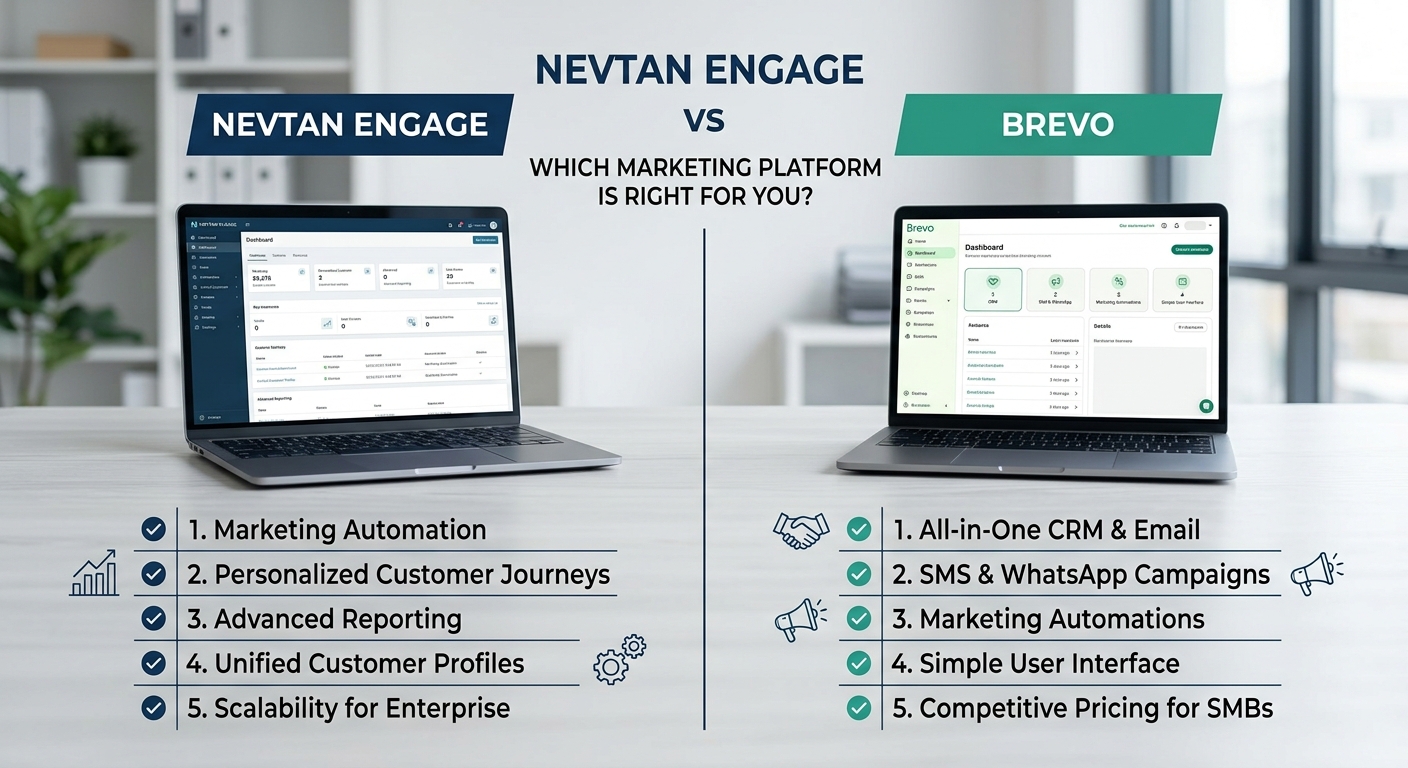
NevTan Engage is the platform this guide references throughout: it unifies customer data into a single profile, then lets you segment by behavior and orchestrate automated journeys across all four channels without custom API work.
Personalization is now an expectation, not a differentiator. McKinsey's research found that 71% of consumers expect personalized interactions and 76% get frustrated when they don't get them.
Behavior beats demographics. Segment by what people have done — pages viewed, links clicked, features used — not by age or job title.
Five steps: unify data → build behavioral segments → map journeys per segment → orchestrate channels → measure and iterate.
Channel escalation matters more than channel count. Start with the least intrusive channel and escalate only if the user doesn't respond.
Suppression is as important as sending. The system needs to know when to stop — after a purchase, after a conversion, after an opt-out.
Why Personalization Drives Conversions
The business case for personalization is well-documented across independent research:
Finding | Source |
|---|---|
71% of consumers expect personalized interactions; 76% are frustrated when they don't get them | McKinsey, Next in Personalization |
80% of consumers are more likely to purchase from brands offering personalized experiences | Epsilon |
Fast-growing companies drive ~40% more revenue from personalization than slower-growing peers | Boston Consulting Group |
The mechanism is straightforward: relevance reduces cognitive effort. When a message clearly connects to something the reader already cares about, they don't have to work out why it's in their inbox. A generic broadcast puts that filtering work on the recipient, and most people resolve it by deleting.
There's a compounding effect too. Consistently relevant messaging builds the kind of trust that raises lifetime value — which is why personalized emails improve customer retention, not just single-campaign conversion rates.
What You Need Before You Start
1. A data audit
You cannot personalize what you do not know. Audit your existing sources — website analytics, CRM, email platform, support tickets — and identify two things: data you're collecting but not using, and data you need but aren't collecting.
The goal is a single customer profile combining:
Behavioral data — pages visited, emails opened, links clicked, features used
Demographic data — industry, job role, location, plan tier
Transactional data — purchase history, subscription status, order value
A useful test: do you know which blog posts a user read before they signed up? That's one of the strongest available signals for what to send them next, and most teams discard it.
2. A platform that unifies channels
Unification is the difference between "we send emails and also SMS" and "an email click at 2 PM triggers a push notification at 2:15 PM." Without a single profile behind the channels, that orchestration requires webhook plumbing and custom code that most marketing teams can't maintain.
This is the core of what NevTan Engage's automation engine does — and our breakdown of how NevTan Engage simplifies email automation walks through the mechanics.
3. Consent management
Personalization is powerful, and it has to respect GDPR, CCPA, and equivalent regulations. You need explicit opt-ins tracked per channel — email consent is not SMS consent — and a working unsubscribe in every message.
NevTan Engage includes one-click unsubscribe (RFC 8058), per-channel opt-in tracking, and engagement-based sunset rules that automatically retire disengaged contacts to protect sender reputation. Full details are in our security and compliance documentation.
Step 1: Unify Customer Data Into a Single Profile
Data silos produce embarrassing messaging. Sending a "Welcome!" email to a two-year customer is the visible symptom; the invisible cost is every behavioral trigger you miss because the signal lives in the wrong system.
Consider a user who visits your pricing page and doesn't convert. That's one of the highest-intent signals you'll ever get. If it sits in your web analytics and never reaches your messaging platform, the opportunity expires silently.
What to do:
Import contacts with consent status and channel opt-ins intact.
Map the events you want to track: page views, email opens, link clicks, SMS replies, purchases, support tickets.
Connect your remaining systems — the NevTan Engage API handles CRM, product, and warehouse integrations.
A unified profile also enables suppression, which is underrated. If someone already bought the product, they should see a cross-sell — not the promotional email for the thing sitting in their cart history. That logic is impossible without a single view.
💡 Start with the Big 3. Email engagement, key page views, and purchase history will give you roughly 80% of the personalization value at a fraction of the setup complexity. Layer in support tickets, SMS replies, and push engagement once the foundation works. Trying to connect every source on day one is how personalization projects stall.
Step 2: Build Interest-Based and Engagement-Based Segments
The old model segmented by demographics. The better model segments by behavior — because a 25-year-old and a 55-year-old can both want your advanced analytics guide, and demographic logic will only get that right by accident.
Core segments to build first
Segment | Definition | Use it for |
|---|---|---|
Engaged | Opened or clicked in last 30–90 days | Default audience for most sends |
New subscribers | Joined in last 30 days | Welcome journey |
Topic interest | Clicked 2+ items in a content category | Relevance-matched sends |
Cold | No engagement in 90+ days | Exclude from broad sends; win-back only |
Topic segments are where relevance compounds. If someone clicks three posts about deliverability, they belong in a Deliverability segment — they get the next deliverability post, and they don't get the SMS marketing post. That single filter lifts open rates and cuts unsubscribes at the same time.
NevTan Engage's segmentation engine supports AND/OR logic, so you can build audiences like "engaged in last 30 days AND interested in Product category AND opted into SMS." For programmatic segment creation, see the segmentation API.
If you're building your segment architecture from scratch, start with customer segmentation fundamentals, then read why smart audience segmentation matters for the strategic case.
Step 3: Map the Journey for Each Segment
A journey moves a user from one state to another — anonymous to subscriber, trial to paid, lapsed to active. Map it before you build it.
Work backward from the goal:
Define the conversion event for this segment.
Identify what the user needs to see to make that decision.
Identify the objections that block it.
Assign each of those to a touchpoint and a channel.
Example: SaaS trial journey
Day | Channel | Content | Purpose |
|---|---|---|---|
1 | Welcome + getting-started guide | Activation | |
3 | Advanced features tutorial | Depth of use | |
5 | Push | Highlight an unused key feature | Behavioral nudge |
7 | SMS | Time-limited upgrade offer | Conversion |
Each step assumes the previous one landed. The visual journey builder handles the conditional logic — if clicked link A, send email B; if not, send email C — along with delays and branch merges.
Two journeys worth building first because they run forever: a welcome email series for new subscribers, and a nurture journey that enrolls users by topic interest. See also our guide on automating the full customer journey from lead to loyal customer.
If you're building for a specific model, the SaaS and B2B lead generation playbooks cover the journey structures that work in each.
Step 4: Orchestrate Multi-Channel Touchpoints
A personalized journey isn't a sequence of emails. It's a coordinated sequence across channels, where the channel choice reflects urgency and user preference.
Channel | Best for | Intrusiveness |
|---|---|---|
Long-form content, detailed explanation, education | Low | |
Push | Re-engaging active app or site users | Low–medium |
Rich media, conversational two-way engagement | Medium | |
SMS | Time-sensitive alerts and deadlines | High |
Our comparison of email vs. SMS vs. WhatsApp marketing goes deeper on where each channel earns its place.
The escalation principle
Cart abandonment, sequenced properly:
+1 hour — Push notification (or email if no app). A gentle nudge.
+24 hours — Email with social proof or a testimonial. Addresses the objection.
+48 hours — SMS with a discount code. Only if still unconverted.
This works because escalating intrusiveness signals rising importance without simply sending more. Critically, the sequence must suppress on conversion — sending a 10% code to someone who just paid full price is worse than sending nothing.
Channel-specific tactics are covered in the WhatsApp marketing starter guide, push notification best practices, and the SMS marketing overview. For retail specifically, see the ecommerce solutions playbook and our guide to how real-time messaging improves retention.
Step 5: Measure, Optimize, and Automate Continuously
Journeys are not set-and-forget. Track:
Primary metrics — delivery rate, open rate, click-through rate, conversion rate, unsubscribe rate Secondary metrics — time on page, pages per session, revenue per recipient
The secondary metrics matter because they tell you whether the traffic you're generating is engaged or just curious. A journey that lifts clicks and produces zero downstream engagement is misfiring.
Test one variable at a time
For email, subject lines are the highest-leverage element — start there, then CTA copy, then the hero image. Our library of subject line formulas gives you testable starting points. For push and SMS, test the hook wording.
Keep a log of winning patterns and feed them back into your email templates so each test compounds instead of evaporating.
⚠️ One caveat on open rates: privacy features like Apple Mail Privacy Protection pre-load tracking pixels regardless of whether a human opened the message, and corporate security scanners generate phantom opens. Treat open rate as directional, and let clicks and conversions decide your winners.
The Technical Engine Behind It
Understanding the architecture helps you evaluate platforms honestly.
Identity resolution
A unified profile database ingests data from your website (JavaScript tracking), messaging platform (webhooks), CRM (API), and support tools. It then resolves those disparate events into one profile using a stable identifier — usually email address or user ID.
This is what lets the system know that the person who clicked your email is the same person now reading your pricing page. Without identity resolution, personalization is guesswork dressed up as strategy.
Real-time segmentation
Segments are dynamic queries, not static lists. When you define "engaged in last 30 days," the engine queries the profile database continuously. A user who opens an email this morning is in the segment this afternoon — no re-import, no manual refresh.
Event-driven automation
The automation engine listens for events — email opened, link clicked, page visited, purchase completed. When one fires, it checks the profile and segment membership, then executes: send, delay, branch, or exit.
This event-driven model is why the system scales. Adding your ten-thousandth contact doesn't change the logic; it just adds another profile the same rules apply to.
The practical payoff is measurable in the metrics you already track. Independent research consistently finds that behaviorally triggered messages outperform batch broadcasts on both open and click rates — which makes sense, because a triggered message arrives when the user has just demonstrated interest, rather than when your calendar said Tuesday.
Common Mistakes to Avoid
Mistake | Why it hurts | Fix |
|---|---|---|
Over-segmentation | 15-person segments produce noise, not insight | Target 100+ members per segment |
No frequency caps | Three journeys can send three messages in one day | Set global caps across all channels |
Weak unsubscribe | Illegal, and it destroys trust | One-click opt-out in every message |
Simultaneous channels | Email and push at the same moment compete with each other | Stagger by hours or days |
Ignoring deliverability | Perfect personalization still fails from the spam folder | Monitor sender reputation continuously |
No suppression rules | Messaging people who already converted | Exit journeys on conversion |
Deliverability deserves particular attention as you scale send volume — our 2026 deliverability guide covers authentication, sender reputation, and inbox placement. For the broader failure patterns, see the top mistakes businesses make in email marketing and the biggest customer retention mistakes.
How to Choose a Personalization Platform
Score any platform against these five criteria:
1. Data unification. Does it build a single profile from email, SMS, push, and web data? If every campaign requires a CSV upload, it won't scale past your first few journeys.
2. Segmentation engine. Can you build dynamic, behavior-based segments with AND/OR logic? Static lists cannot support real-time personalization.
3. Journey builder. Visual, drag-and-drop, with conditional branching and time delays? Visual builders reduce errors and dramatically speed up iteration.
4. Channel coverage. Email, SMS, push, and WhatsApp natively from one interface? Stitching four tools together recreates the data silos you're trying to eliminate — and multiplies your costs.
5. Compliance and deliverability. One-click unsubscribe (RFC 8058), engagement-based sunset rules, per-channel opt-in tracking, and a signed DPA.
Compare how NevTan Engage scores on the pricing comparison page, or read the head-to-head breakdowns against Mailchimp and Customer.io.
FAQ
How long does it take to see results from personalized journeys?
Open and click-rate improvements often appear within 2–4 weeks. Conversion improvements typically take 1–3 months, because journeys need to run their full length and accumulate enough data to optimize against.
What's the minimum data needed to start?
Email engagement (opens and clicks) plus basic website behavior. Those two sources alone support Engaged vs. Cold segmentation and topic-interest segments — enough for meaningful personalization.
How does NevTan Engage handle GDPR and CCPA compliance?
Built-in consent management, one-click unsubscribe (RFC 8058), data deletion request handling, and engagement-based sunset rules that stop sending to disengaged contacts. See the privacy policy and DPA for specifics.
Does this work for both B2B and B2C?
Yes — the segmentation logic is identical. The channel mix differs: B2B typically weights toward email and longer nurture cycles, while B2C sees stronger results from SMS and push. Both are covered in the B2B and ecommerce playbooks.
What's the right frequency for multi-channel messages? A reasonable starting point: 1–2 emails per week, 1–2 push notifications per week, and SMS reserved for high-value, time-sensitive moments (1–2 per month maximum). Then adjust based on your own unsubscribe and complaint rates.
How do I A/B test a multi-channel journey? One variable at a time, in order of leverage. Test the email subject line first, lock in the winner, then test the push copy. Testing two variables simultaneously tells you the journey improved without telling you why.
What's the single most impactful thing I can do today?
Unify your data. Even a CSV export from your email platform merged with CRM data is a starting point — import it, build an Engaged segment, and launch one journey. Our guide to sending your first campaign covers the first hour.
How are per-channel opt-outs handled?
Independently. If a contact opts out of email but remains opted into SMS, NevTan Engage continues SMS delivery and suppresses email. Consent status is tracked per channel, never globally inferred.
Can I run this without engineering support?
Yes for the core workflow — imports, segments, journeys, and templates are all no-code. Custom event tracking and deep CRM syncs use the API and typically need developer time once, at setup.
Start Building Your First Journey
You have the playbook, the architecture, and the evaluation framework. What's left is execution.
Start narrow. Pick one segment — new subscribers is the easiest — and build a three-step welcome journey. Measure it for two weeks. Then add a second journey for a topic-interest segment, and a third for cart abandonment or trial activation, depending on your model.
NevTan Engage unifies your customer data into a single profile, gives you behavior-based segmentation, and lets you orchestrate email, SMS, push, and WhatsApp from one visual journey builder — with compliance and deliverability handled underneath. See plans and pricing or read how teams solved low customer engagement with a structured journey system.
Your customers are already telling you what they want through their behavior. The only question is whether your messaging is listening.